
Why Every Lab Needs the Right Reconstitution Solution ?

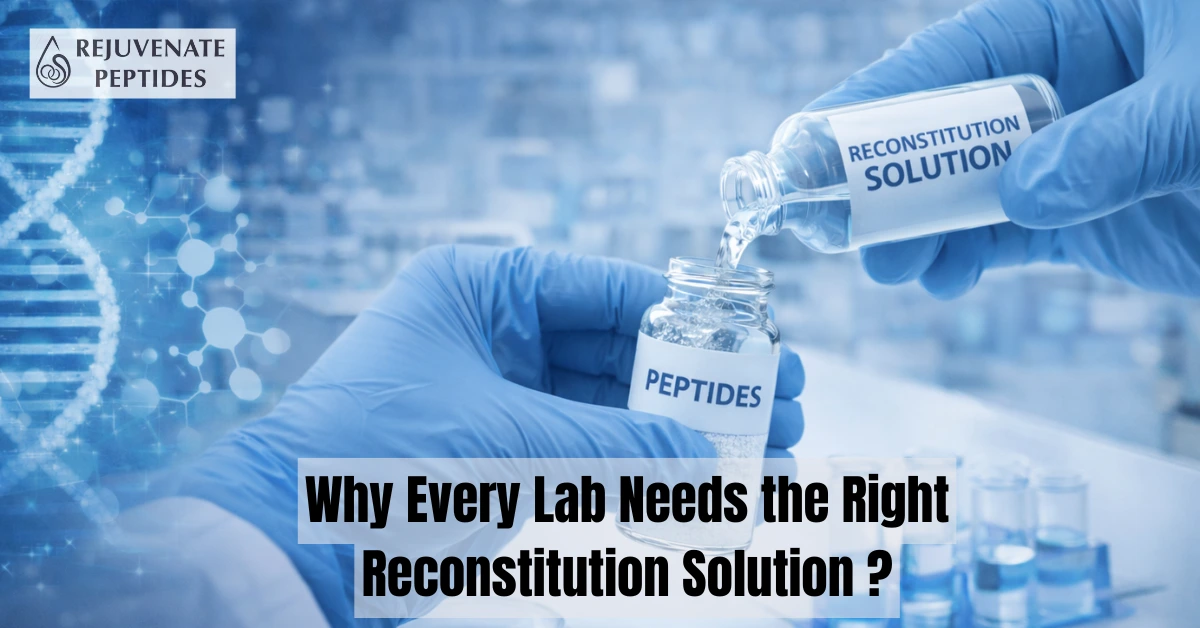
Have you ever encountered the puzzle of receiving vial of lyophilized peptide powder and wondering what steps come next? Usually in research settings, freeze-dried peptides arrive frozen-dry for optimal storage and transport stability; before any experiment may start, they must first be properly dissolving into solution for experiments to start. Reconstitution solutions play an essential part here, as without proper solutions, accurate preparation cannot happen for laboratory workflows.
The global peptide research market continues to expand as molecular biology and biochemical studies grow worldwide. With more laboratories working on protein analysis, receptor mapping, and assay development, proper peptide handling has become a foundational step in research design. Rejuvenate Peptides offers reliable reconstitution solutions for peptides to support accurate dilution, stable preparation, and consistent documentation. At their laboratory materials are clearly labeled and research-specific documentation provided; all products provided to Rejuvenate are intended solely for laboratory research use – never human or veterinary applications!
What Is a Reconstitution Solution?
Reconstitution solutions are sterile liquid solutions used to dissolve freeze-dried peptide powder. Peptides may often be shipped as powder form due to extended shelf life and molecular integrity concerns; however, prior to conducting lab experiments, researchers must convert this powder form to liquid form that meets study specifications.
At first glance, reconstitution may appear straightforward but requires great care to achieve optimal results. Misusing solvents or handling can result in instability, incomplete dissolution, contamination, or instability – selecting an ideal peptide reconstitution solution helps preserve structural integrity as well as provide reliable experimental outcomes.
Why Proper Reconstitution Matters in Research
Peptides are delicate molecules. Their behavior in experiments depends heavily on how they were prepared; even minor variations in solvent choice, temperature, or mixing technique can significantly change results.
Using the right reconstitution solution for peptides helps laboratories:
- Achieve consistent concentrations
- Maintain solution clarity
- Reduce contamination risk
- Preserve peptide stability during storage
Careful preparation supports reproducibility, which remains one of the most important principles in scientific research.
Common Types of Reconstitution Solutions
The type of solution selected depends on the peptide’s characteristics and the experimental design.
Bacteriostatic Water
This is commonly used in research settings. It contains sterile water with a small amount of preservative to reduce bacterial growth when multiple withdrawals are required.
Sterile Water
Sterile water without preservatives is often used for single-use preparation when the solution will be used immediately.
Buffered or Specialty Solutions
Researchers should consult product documentation prior to selecting an ideal solvent for dissolving certain peptides. Some are best suited for buffered or slightly acidic solutions.
Regardless of the choice, all solutions must be sterile and appropriate for laboratory research use only.
A Practical Overview of the Reconstitution Process
While protocols differ between laboratories, most follow similar preparation steps.
- First, prepare a clean workspace. Sanitize tools and surfaces.
- Allow the peptide vial to reach room temperature before opening.
- Draw the appropriate volume of reconstitution solution using sterile technique.
- Add the liquid slowly along the inside wall of the vial. Avoid injecting directly onto the powder.
- Gently swirl the vial to dissolve. Do not shake aggressively.
- Label the vial with concentration, date, and storage instructions.
Taking time during this step helps avoid bubbles, aggregation, or incomplete dissolution.
Midway through complex projects, many laboratories rely on consistent preparation methods and documented materials from suppliers like Rejuvenate Peptides to maintain internal workflow standards. As always, all materials are designated strictly for laboratory research use only.
Storage and Handling Best Practices
Once dissolved, peptide solutions require proper storage.
Researchers typically:
- Store solutions at refrigerated temperatures unless otherwise directed
- Avoid repeated freeze-thaw cycles
- Document preparation dates
- Discard solutions that show cloudiness or contamination
Clear labeling and controlled storage reduce variability in experimental outcomes.
Common Questions Researchers Ask
What happens if the peptide does not dissolve fully?
Some peptides require gentle swirling and time. If particles remain, reviewing solvent choice and temperature conditions often resolves the issue.
How do I calculate the final concentration?
Concentration depends on how much reconstitution solution is added during reconstitution; dissolving 5 mg of peptide in 1 mL results in different concentration than dissolving it in 2 mL; to achieve maximum effectiveness from experimental planning, accurate calculations must accompany experimental planning for maximum success.
Can regular water be used?
No. Only laboratory-appropriate solutions should be utilized. Non-sterile water introduces risk and compromises research integrity.
Why This Step Deserves Attention
Preparing peptides often goes underrated, yet its preparation has an immense influence on research reliability. A high-quality reconstitution solution will ensure your peptide dissolves correctly and consistently, while careful attention during its creation ensures accurate data collection with reduced variability.
As peptide research continues to grow, proper preparation methods remain essential. Laboratories working with peptide reconstitution solution materials should prioritize sterile techniques and documentation as well as compliance with research-only standards.
Conclusion
Researchers sourcing materials from Rejuvenate Peptides enjoy clear documentation and research-specific labeling, which help maintain efficient workflows; all our products remain solely intended for laboratory research use and cannot be approved as clinical or therapeutic remedies. When handled responsibly, using proper reconstitution solutions ensures clarity, stability, and consistency at every step in scientific investigation. Rejuvenate Peptides provides quality reconstitution solutions that form the cornerstone of successful peptide preparation, from accurate concentration calculations and storage practices all the way through reliable laboratory outcomes.